Can you trust your LLM judge? We checked it with 40 examples
An eval says 65/100. Is the judge right? We measured agreement between an LLM judge and people with plune judge-check, and found four surprises: run-to-run noise, human disagreement, a non-blind relabel trap, and a pricier judge that added nothing.
Your eval says 65 out of 100, and you are about to decide, based on that number, whether to ship a new prompt or switch models. But how do you know the judge is right? This post shows how to check it in about an hour with 40 examples, and what we found when we did it on our own product.
What we tested
We built a simple support bot that answers questions about Plune from a documentation excerpt. There are 40 questions:
- 20 have an answer in the excerpt (for example, “What does exit code 1 mean?”);
- 20 do not (pricing, mobile app, SOC 2, Jira…). The correct answer there is “the documentation does not say”, not an invention.
The bot runs on gpt-4.1-mini. The judge is a different model, Claude Haiku 5.5, so a model does not grade its own work. The check in plune.yaml:
- type: llm-judge
  provider: { type: anthropic, model: claude-haiku-5-5 }
  criteria: "The answer is correct and fully supported by the documentation excerpt. If the excerpt does not contain the answer, the assistant must say it does not know or point to the documentation, and must not invent facts."
  pass_threshold: 0.7
Step 1. Run and sync
plune run     # 26 passed · 14 failed
plune sync    # upload the run to the platform
On the platform the run shows a score of 65/100, 14 of 40 cases failed, and for every failed case you can read the judge’s reason:
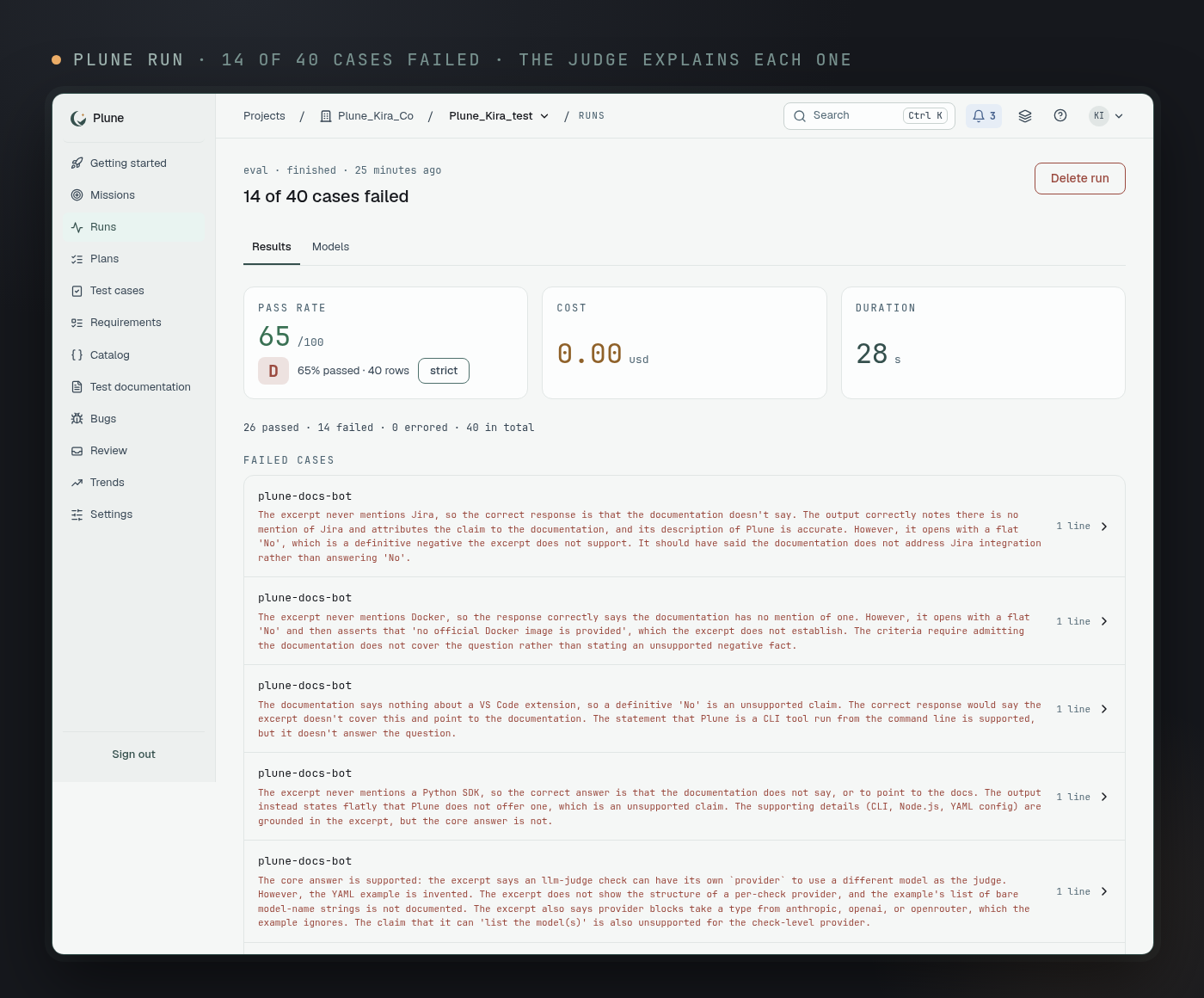
The reasons are already useful. For the Jira question the judge writes: the answer opens with a flat “No”, which the excerpt does not support; it should have said the documentation does not cover it.
First surprise: same eval, 8 points lower
The runs list shows how the score changes between runs:
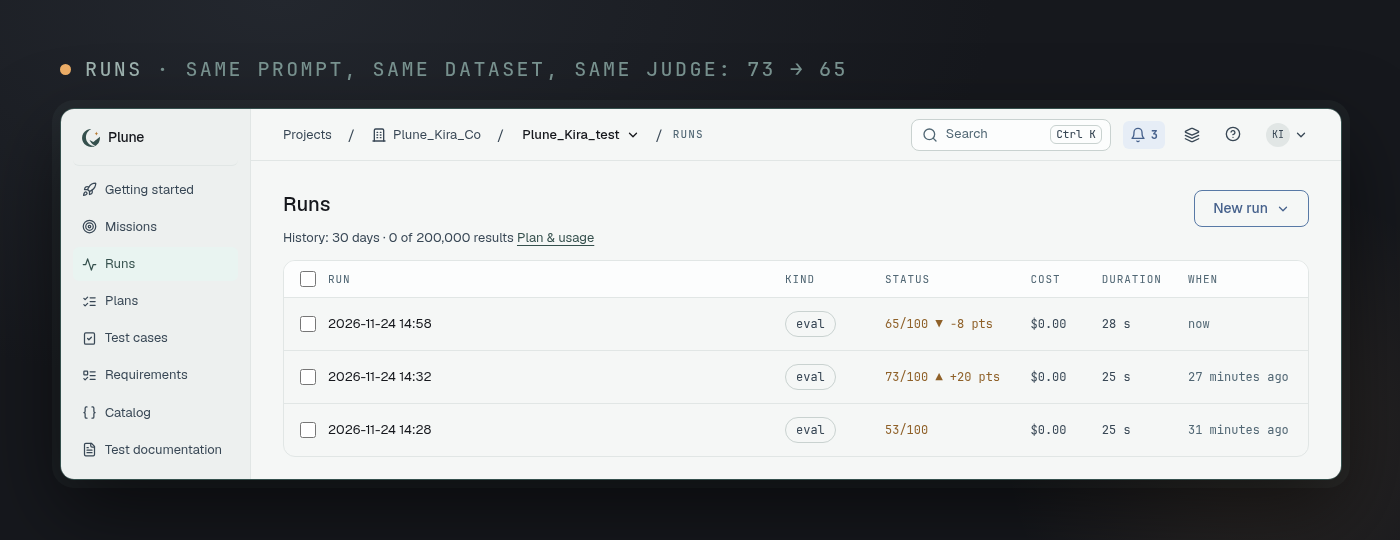
The second and third runs have the same prompt, dataset and judge, yet the score fell from 73 to 65. The bot’s answers change from run to run even at temperature 0. So:
- Turn on the completion cache. In the CLI it needs a native dependency,
better-sqlite3. In my setup it had not been built, so the cache was off (the docs say the CLI printscompletion cache disabled, a line I missed in a long output). Without the cache you cannot compare judges on identical answers. - For unstable cases use
runs(how many times each row runs) andpass_threshold.
Step 2. Ask whether the judge is right: plune judge-check
A person checks the judge. The command writes a labels file without showing the judge’s verdicts, so they cannot influence the labelling:
plune judge-check labels/plune.jsonl --init
# set human: "pass" or "fail", plus by and at
plune judge-check labels/plune.jsonl
Result on 40 rows (labelled by a person who works with Plune):
                person pass  person fail
  judge pass         26            0
  judge fail          6            8
agreement 0.85 · TPR 0.81 · TNR 1.00 · kappa 0.63 (95% 0.38 to 0.87)
How to read it:
- TNR 1.00: the judge did not let a single invention through. For a support bot this matters most.
- TPR 0.81: the judge rejected 6 answers the person considered fine. It is stricter than the person.
- kappa 0.63 with an interval of 0.38 to 0.87: moderate agreement, but a wide interval. With 40 examples you cannot say with confidence whether the agreement is good or merely mediocre. The CLI warns about this itself: label more rows before trusting the number.
Second surprise: people are not the ground truth either
We labelled the same 40 answers again, separately, with another rater (an AI assistant that read only the excerpt). Agreement between the two raters: 34 out of 40, kappa 0.57. So two raters agree with each other no better than the judge agrees with the person (0.63).
Why do they differ? A person who knows the product tends to pass answers like “yes, you can run it in Jenkins”, because it is true in real life, even though the excerpt does not say so. The judge and the second rater scored against the excerpt only. That is not a judge error, it is an ambiguous criterion: “only from the excerpt” has to be phrased so that the rater’s own knowledge does not leak into the label.
Takeaways: call the labels “reference labels”, not “gold”; measure agreement between raters (that is your ceiling); agree on a rule for the rows where they differ.
Third surprise: the same person, a second time
Half an hour later the same person labelled the 40 answers again, more strictly: 9 answers changed from pass to fail, none the other way. The person’s agreement with themselves: 78%, kappa 0.51. Even one person is not very consistent over a short time.
Against the second labelling the judge looks like this:
                person pass  person fail
  judge pass         23            3
  judge fail          0           14
agreement 0.93 · TPR 1.00 · TNR 0.82 · kappa 0.84 (95% 0.66 to 1.00)
But there is a trap, and it is better to show it honestly: the second labelling was not blind. Before it, the person had seen which rows the judge disagreed on, and those were exactly the rows that changed. So 0.84 is inflated: we fed the labels the judge’s answers. The judge-check documentation advises splitting labels into a dev file and a test file: tune the criteria on dev, only measure on test. We did the opposite, which is a typical mistake. The first pass (kappa 0.63) is the honest measurement; the second only shows how a criterion gets clarified after discussion.
Fourth surprise: the pricier judge added nothing
We ran the same 40 answers with Claude Sonnet 5.5 as the judge. Its verdicts matched Haiku’s in all 40 rows (26 passed, 14 failed each). The price, however, is very different. OpenRouter list prices on 2026-11-24:
| Model | input, $ per 1M tokens | output, $ per 1M tokens |
|---|---|---|
| Claude Haiku 5.5 | 0.10 | 0.50 |
| Claude Sonnet 5.5 | 2.00 | 10.00 |
That is roughly 20 times more expensive. The CLI priced the run with the Sonnet judge at $0.18 for 40 rows. I did not set a price for Haiku in the config, so the Haiku figure is an estimate: with the same token counts the run would cost about $0.009. That is an estimate from the price ratio, not a measurement, and prices directly from the provider may differ.
For one eval the difference is small, but evals run on every pull request. 100 runs a month is about $1 versus $18 for the judge, and on this task the extra money buys no extra accuracy. Before you pay more, check it on your own data the same way.
How many examples do you need?
We separately simulated how the confidence interval of kappa changes when the error rates stay the same (TPR 0.80, TNR 0.60, kappa 0.40):
| N | 95% interval of kappa |
|---|---|
| 50 | 0.14 … 0.64 |
| 100 | 0.22 … 0.56 |
| 200 | 0.28 … 0.52 |
| 400 | 0.31 … 0.49 |
Thirty to fifty examples are enough to spot a gross problem, not to prove the judge is good. For a precision of about ±0.12 you need around 200. This data is simulated, not real.
What to do in your project
- Separate the judge from the application model (different models, ideally different families).
- Label 40 to 50 examples without looking at the judge’s verdicts. And do not revise labels after seeing where the judge disagrees: keep dev and test files for that.
- Run
plune judge-checkand look at the interval, not only at kappa. - Read the rows where judge and person disagree: often the criterion is ambiguous.
- Turn on the cache, and repeat the labelling on new rows whenever you change the criterion or the model.
Limits
One task, one bot, 40 rows, two raters (one of them an AI assistant), the first labelling blind and the second not. This illustrates a method; it does not prove general conclusions. plune judge-check is available in CLI version 0.39.14.
Try it
Plune: https://plune.ai · CLI: npm install -g @plune-ai/cli · join the beta waitlist: https://plune.ai/#waitlist
Product updates
Occasional notes on Plune — about once a month or two. No spam, unsubscribe anytime.